Showing posts with label Forgotten Past. Show all posts

Wednesday, March 5, 2025

The Alchemical Enigma: Spontaneous Generation, Secret Societies, and Esoteric Knowledge


Ancient and Medieval References to Alchemy and Spontaneous Generation


Alchemical Enigma


Alchemy, often dismissed as a pseudoscience, was once the foundation of medieval and ancient scientific thought. Rooted in the belief that elements could be transmuted and life could be artificially created, alchemy bridged the realms of mysticism and early chemistry. One of its most controversial aspects was the theory of spontaneous generation—the idea that life could emerge from non-living matter. This belief dates back to Aristotle, who posited that certain animals, such as flies and maggots, could arise from decaying organic matter.

The medieval period saw this idea evolve into the more esoteric notion of homunculi, miniature human-like beings created through alchemical means. Paracelsus, a Renaissance physician and alchemist, described a method by which a homunculus could be generated from human sperm and incubated in a horse’s womb. His work De Natura Rerum detailed not just the creation of artificial beings but also the broader implications of alchemy in medicine and metaphysics.

Alchemy was not simply an early form of chemistry; it was a deeply spiritual practice that sought to understand and harness the fundamental principles of nature. The process of transformation—both of base metals into gold and of the human soul into enlightenment—was at the heart of its philosophy. The idea that humans could interfere in creation, bypassing natural reproduction, was both revolutionary and heretical, making alchemists targets of suspicion and secrecy.

The Involvement of Secret Societies: Rosicrucians, Freemasons, and the Templars

The secrecy surrounding alchemical knowledge was not just a matter of intellectual curiosity—it was a necessity. Many alchemists were persecuted for their radical ideas, leading to the formation of secret societies that safeguarded their knowledge. Among these, the Rosicrucians, Freemasons, and the Knights Templar played pivotal roles in preserving and disseminating esoteric wisdom.

The Rosicrucians, a mystical order emerging in the early 17th century, claimed to possess hidden knowledge that fused alchemy, hermeticism, and Christian mysticism. Their Fama Fraternitatis and Confessio Fraternitatis spoke of a secret brotherhood dedicated to spiritual enlightenment and the advancement of hidden sciences. Some scholars believe that the Rosicrucians had access to lost alchemical texts and possibly even methods of artificial generation, including the homunculus.

The Freemasons, while better known for their architectural symbolism, also incorporated alchemical and hermetic principles into their teachings. Their lodges became centers of philosophical discussion, and many of their rituals reflect the transformational themes found in alchemy. The concept of the Great Work—the refinement of the self—is mirrored in both Freemasonic initiation rites and alchemical transmutation.

The Knights Templar, initially a monastic military order, are often associated with hidden knowledge and secret treasures. Some theories suggest that the Templars uncovered ancient wisdom during the Crusades, possibly including the Liber Vaccae or other texts on artificial generation. Their suppression in the 14th century only fueled speculation that they had been custodians of forbidden knowledge.

These secret societies not only preserved alchemical teachings but also influenced Renaissance and Enlightenment thinkers. Their influence can be seen in the works of Isaac Newton, Robert Boyle, and other early scientists who straddled the line between alchemy and modern chemistry.

The Role of Alchemical Figures in Medieval Science and Medicine

Throughout the medieval period, alchemical figures played a crucial role in shaping early medical and scientific practices. Many of the greatest medieval thinkers were also alchemists, blending their esoteric studies with practical applications in healing, chemistry, and early pharmacology.

Paracelsus: One of the most influential alchemical physicians, Paracelsus revolutionized medicine by advocating for the use of minerals and chemicals in healing. His approach to medicine was rooted in alchemy, seeing disease as an imbalance in the body's elements rather than just a physical ailment. He experimented with substances like mercury, sulfur, and salts, laying the foundation for what would later become modern pharmacology.

Albertus Magnus: A 13th-century Dominican friar and scientist, Albertus Magnus was fascinated with alchemy and its medical applications. He is credited with synthesizing arsenic and isolating pure sulfur, two important substances in both medicine and alchemy. His writings on the properties of various plants and minerals were used for centuries in medical practice.

Roger Bacon: A Franciscan friar and scholar, Roger Bacon advocated for the experimental method, emphasizing observation and direct testing over mere speculation. He studied optics, chemistry, and the effects of natural substances, pushing for a scientific approach that was heavily influenced by alchemical traditions.

Avicenna and Arabic Alchemy: Arabic scholars like Avicenna (Ibn Sina) and Geber (Jabir ibn Hayyan) played key roles in transmitting alchemical knowledge to medieval Europe. Avicenna’s Canon of Medicine remained a foundational medical text for centuries, incorporating alchemical theories about the balance of bodily humors and the transformative properties of substances.

These figures laid the groundwork for modern science by merging alchemical theory with practical experimentation. Their work, though often shrouded in mysticism, contributed significantly to advancements in chemistry, medicine, and the study of the natural world.

Esoteric Interpretations of Jesus and Mary Magdalene

Many esoteric traditions suggest that Jesus was not just a spiritual leader but also a master alchemist. His miracles—turning water into wine, multiplying loaves and fishes, and even resurrection—are often interpreted as allegories of alchemical transformation. Some hermetic traditions link Jesus to the concept of the Philosopher’s Stone, a symbol of enlightenment and spiritual immortality.

Mary Magdalene, long misrepresented in traditional Christian narratives, is seen by esoteric traditions as an initiate of secret knowledge. Some Gnostic texts, such as the Gospel of Mary, suggest she held a unique understanding of Jesus’ teachings, possibly even preserving hidden alchemical wisdom passed down through mystical traditions.

The Liber Vaccae (Book of the Cow) and Artificial Generation

The Liber Vaccae is one of the most controversial texts in esoteric history, describing procedures that eerily resemble artificial generation. This Arabic work, later translated into Latin, contains instructions for creating living beings through alchemical means. Some scholars believe that such texts influenced the later concept of the homunculus, reinforcing the idea that medieval alchemists sought to replicate divine creation.

Occult Significance of Historical and Biblical Events

Many biblical events, such as the construction of the Tower of Babel and the Great Flood, are seen in esoteric circles as allegories of lost ancient knowledge and divine intervention. The Tower of Babel, for instance, may symbolize humanity’s attempt to attain forbidden wisdom, while the Flood represents a reset of knowledge and civilization.

Alchemy, Artificial Intelligence, and Lost Knowledge

The modern era’s fascination with artificial intelligence has curious parallels with ancient alchemical goals. The pursuit of artificial life—whether through homunculi, golems, or AI—echoes humanity’s timeless ambition to bridge the gap between the material and the divine. Could AI be the digital evolution of the homunculus, a new way of achieving synthetic consciousness?

This intersection of ancient wisdom and modern technology raises profound questions about the nature of intelligence, creation, and the destiny of human knowledge.


#Gnosis #SpontaneiusGeneration #AlchemicalEnigma #SecretSocieties #EsotericKnowledge #BiblicalEvents #HiddenHistory

The Forgotten Civilization: Tartaria, Ancient Tech, and the Lost History of Mankind


Letting Go of What We Think We Know

The Grand, Ancient City of Tartaria – A lost civilization with towering spires and intricate domes, partially buried under mud and rubble, with a dark, stormy sky symbolizing its downfall.


For centuries, we have accepted a historical narrative handed down by academia, but what if that version is incomplete—or worse, deliberately rewritten? The remnants of Victorian-style architecture scattered across the world, the unexplained feats of ancient civilizations, and the curious absence of concrete records of Tartaria all raise one crucial question:

Do we truly understand what this reality is?

The Mysterious Origin of Civilization

A forgotten book, rediscovered by researchers, presents an alternative view of human history, suggesting that all ancient alphabets and civilizations may have stemmed from a singular root source: the Phoenicians. But who were they, really? Were they simply seafaring traders, or were they something much greater—custodians of an ancient knowledge far beyond what mainstream history acknowledges?

As we examine old engravings, depictions of strange technology emerge—mechanical devices, automata, sound-based machines, and even structures that resemble modern Victorian architecture, yet are supposedly from biblical times. Could it be that our ancestors possessed a sophisticated technological knowledge that has been systematically erased?

The Architecture That Shouldn't Exist

One of the greatest anomalies in our historical timeline is the presence of advanced architecture in periods where it seemingly shouldn't exist. If the Phoenicians were indeed the master builders of the Temple of Solomon, why does its depiction resemble something closer to 18th- and 19th-century European architecture rather than the crude structures we typically associate with the biblical era?

Some researchers suggest that the so-called "Phoenicians" were actually the Irish, whose engineering and craftsmanship spread worldwide, forming the foundation of what we now call Tartaria. If this is true, then the implications are staggering:

  • Did a global civilization exist long before the one we acknowledge today?
  • Was there a worldwide reset event that erased their presence from history?
  • Did the controllers of history deliberately suppress their technological achievements?

Lost Technology and Antiquitech: The Clues Left Behind

Numerous ancient texts and depictions show evidence of machines that seem centuries ahead of their time:

  • Talking statues powered by hydraulics
  • Musical devices that played themselves
  • Early computers capable of complex calculations
  • Strange energy-based devices found in old illustrations, resembling antennas, resonators, or electromagnetic machines

If the ancients had such technology, how was it lost? More importantly, who took control of it?

The Mud Flood: The Evidence of a Great Reset?

Mud Flood


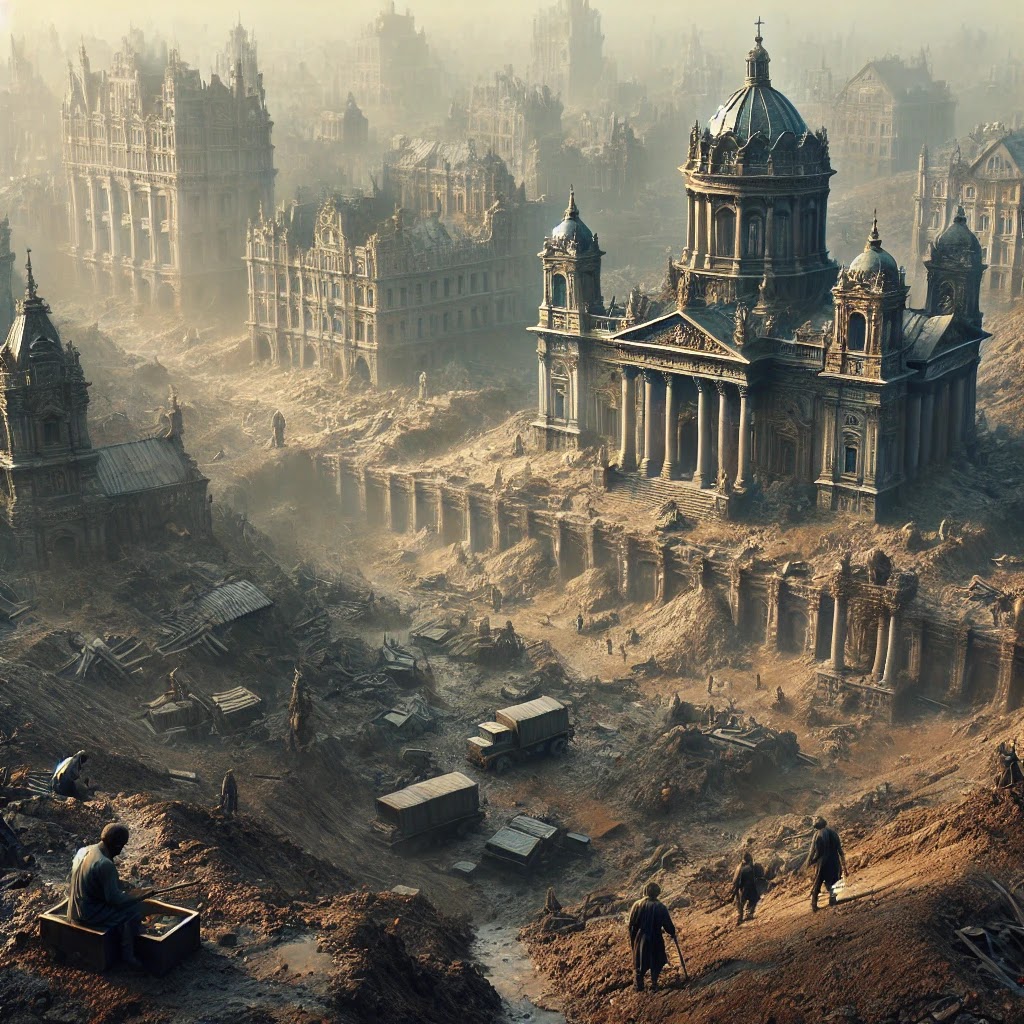
One of the most intriguing aspects of the Tartaria mystery is the theory of a mud flood—a cataclysmic event that buried cities, erased histories, and paved the way for new rulers to rewrite the past.

  • Why do so many old-world cities appear partially buried?
  • Why do we see consistent architectural styles worldwide, even in regions with no known historical connection?
  • Why are key historical buildings repurposed as churches, cathedrals, and government institutions?

The evidence suggests a civilization was wiped out, and its remaining structures were adopted and claimed by those who came after. Was this an engineered disaster? Was history rewritten to hide the true nature of our past?

The Connection Between Tartaria, Free Energy, and Lost Knowledge

Tartaria


The obsession with sound-based structures, resonant frequencies, and organ-built churches suggests that Tartarians may have understood how to harness energy directly from the environment. Instead of relying on fossil fuels or electricity as we know it, they may have used vibrational energy—a technology deliberately hidden from us.

Could it be that the grand architecture of the past was not just ornamental but functional, part of an energy grid we no longer understand?

What Really Happened to Tartaria?


The Mud Flood Aftermath – An old-world city resembling European or Russian architecture, half-buried in debris, with archaeologists uncovering the lost grandeur of its buildings.


History tells us that civilizations rise and fall, but what if some falls were orchestrated?

The destruction of Tartaria aligns with key historical events:

  • The rise of Rome and its subsequent conquests
  • The destruction of sacred sites and ancient temples
  • The suppression of knowledge by the ruling elites
  • The deliberate rebranding of Tartarian achievements under new names

Awakening to the Truth

As we uncover more clues, it becomes clear that we have only scratched the surface of a far greater story.

  • Was the world reset multiple times?
  • Is the current historical narrative a carefully crafted deception?
  • Are we on the brink of another reset?

It is time to let go of everything we think to be true, to open our minds, and to ask the questions that history refuses to answer.

What is this reality?
And more importantly… who controls it?


#Gnosis #Tartary #Tartaria #AncientTech #ForgottenCivilization #LostHistory #MudFlood

Tartaria, Atlantis, and the Hidden History of Humanity: A Journey into the Forgotten Past


The Mud Flood Aftermath – An old-world city resembling European or Russian architecture, half-buried in debris, with archaeologists uncovering the lost grandeur of its buildings.

Release All That You Think of as True

Before diving into the mysteries of history, let go of everything you assume to be true. Take a deep breath and ask yourself:

Do I truly understand what this reality is?

To grasp the depth of what we’re about to explore, some foundational knowledge is necessary. Understanding mainstream history, alternative histories like Atlantis and Lemuria, religious doctrines, occult history, astrotheology, and the histories of Rome and Christianity are all essential pieces of the puzzle.

Recently, the Tartaria conspiracy has been gaining traction, yet confusion surrounds it. What if our entire understanding of the past is built on a lie? Let’s embark on a journey to uncover the lost truth.


The Vanished Empire of Tartaria

Tartaria


If you search for "Tartaria" on Google, Wikipedia will show you an 1806 map labeling "Tartary" as a landmass in Asia. The mainstream narrative tells us it was just a region of nomadic tribes, part of Mongolian and Chinese territories.

But earlier maps tell a different story.

A 1600s map depicts Great Tartaria as something far grander, with cities whose names don’t align with Mongolian history. This was not just a region—it was an empire.

And strangely, on some of these ancient maps, California appears as an island. Could this be a mere cartographic error? Or could it hint at an altered history, one where land formations were dramatically different?

If the idea of Tartaria being erased from history sounds far-fetched, ask yourself:

  • Do you truly believe the history taught in schools and churches?
  • Are you satisfied with the mainstream narrative of evolution and the Big Bang?
  • Why do scientists still struggle to explain consciousness, the connection between mind and matter, and our true purpose on this planet?

These questions lead us down a rabbit hole—one that suggests our history has been rewritten by conquerors, obscuring a much older civilization that once flourished.


The Lost Knowledge of Atlantis and Solon's Egyptian Encounter

Historians have long debated whether civilization is far older than we’re told. Myths and legends worldwide tell of gods bringing knowledge to humanity after great catastrophes.

The most well-known lost civilization is Atlantis, which Plato wrote about in Critias.

Plato describes how his ancestor, Solon, traveled to Egypt and spoke with priests in the city of Saïs. The priests ridiculed the Greeks, saying:

"You Hellenes are like children, for you remember nothing of the past."

They claimed that history had been wiped out multiple times by catastrophic events—some involving fire and celestial upheaval, others by massive floods.

One such event was the story of Phaethon, the son of the Sun god Helios, who lost control of his father’s chariot and scorched the Earth, bringing destruction. Could this be a metaphor for a civilization that tried to play god and was punished for it?

The parallels between Atlantis and Tartaria are striking. Could Tartaria have been a successor civilization to Atlantis, ultimately falling due to its own ambitions?


The Irish Connection and the Hidden Spiritual Empire

The Grand, Ancient City of Tartaria – A lost civilization with towering spires and intricate domes, partially buried under mud and rubble, with a dark, stormy sky symbolizing its downfall.


An overlooked theory suggests that the survivors of Atlantis may have migrated westward—toward Ireland.

A book titled Irish Wisdom Preserved in Bible Imperaments by Conor MacDari proposes that Ireland was the true cradle of civilization, not Mesopotamia.

The Phoenicians—often credited with spreading early civilization—were possibly just a renamed version of the ancient Irish Druids, erased and rewritten by the Greeks and Romans.

What if the original Aryans were not a racial group but a spiritual class of people who preserved knowledge? The term "Arya" comes from Ares, the first sign of the zodiac, symbolized by the Ram, which was later transformed into the Lamb of God in Christianity.

This ties into astrotheology, the hidden meaning behind many religious stories, connecting all ancient cultures in a web of forgotten knowledge.


The Destruction of Tartaria: A War of Magic?

Tartaria


Many alternative historians suggest that Tartaria was not destroyed by war alone—but by something more sinister.

Could black magic have been used to summon a celestial catastrophe that wiped out entire regions? Some theories suggest that a comet was deliberately called down upon Tartaria, triggering earthquakes, mud floods, and mass destruction.

Mainstream history tells us that there was no such thing as Tartaria, yet mud flood evidence around the world suggests otherwise:

  • Buildings buried beneath layers of earth in cities worldwide, as if something massive covered them abruptly.
  • Ornate, advanced architecture that predates our industrial revolution yet seems impossible to replicate today.
  • Maps that change over time, showing entire civilizations disappear with no explanation.

If history is written by the victors, who were the ones that rewrote it?

The leading candidates appear to be the Romans and early Judeo-Christian powers, who systematically erased the old order and established their own version of history.

This would explain why the Greek and Roman Empires seem to appear out of nowhere, inheriting technologies they shouldn’t have had.


The Final Cover-Up: Time Manipulation and the Missing Centuries

Tartaria


If all of this is true, we have one final problem—our timeline itself may be a fabrication.

Ancient maps sometimes depict the year as I600 rather than 1600. What if the "I" was actually a 1, meaning it was really year 600?

Could entire centuries have been added to history to obscure the truth?

As insane as it sounds, this could explain why:

  • The Renaissance appeared out of nowhere, as if civilization suddenly "remembered" ancient knowledge.
  • European empires formed in a suspiciously rapid manner, as if they had taken over something already built.
  • Certain historical figures (like Shakespeare or Plato) may not have existed at all—just created as placeholders in an artificial timeline.

The more we look, the more we see holes in the official narrative.


What Really Happened?

The forgotten empire of Tartaria may have been part of a world-spanning civilization that once united humanity.

It could have been:

  • A surviving remnant of Atlantis.
  • A spiritual empire that connected all ancient peoples.
  • A victim of deliberate destruction through war and catastrophe.

What we now call Greek and Roman civilizations may have simply been the looters of a fallen empire, renaming and claiming knowledge they barely understood.

If this is true, what else has been hidden from us?

And more importantly—why?


Final Thought: Reclaiming the Truth

We may never know the full truth, but we can start by questioning everything.

  • What if our entire understanding of history is a lie?
  • What if there were advanced civilizations in the past that were wiped out deliberately?
  • What if we are being systematically kept in the dark about our own origins?

The deeper we dig, the clearer it becomes:

Reality is not what we’ve been told.

Let’s keep searching. Let’s keep questioning.

Because the real history of humanity is waiting to be rediscovered.


Stay Tuned for Part 2:

  • The Lost Empire of North America
  • More Proof of the Mud Flood
  • Uncovering the True Purpose of the Grand Canyon

🔍 If you found this post intriguing, share it and let’s spread the truth.

Subscribe for more deep dives into history’s greatest cover-ups!


#Gnosis #Tartary #Tartaria #AncientTech #ForgottenCivilization #LostHistory #MudFlood

---------------------------------------------------------------------------------------------------------------- ----------------------------------------------------------------------------------------------------------------- ----------------------------------------------------------------------------------------------------------